



You don't buy wedding rings every day. And yet, in the best case scenario, they will accompany you for the rest of your life. Between the anticipation, budget planning, and wedding organization, details sometimes take a back seat. Many couples only realize afterwards that they would have liked to have considered certain aspects earlier.
The good news:
With a little guidance, typical mistakes when buying wedding rings can be easily avoided.
This guide will help you make an informed decision—calmly, knowledgeably, and with an eye on what really matters.
Mistake 1 – Starting the selection process too late
Wedding planning is often a busy process. The venue, outfits, invitations—there are many things to consider. Wedding rings sometimes get pushed to the back of the queue.
But high-quality rings take time:
• Consultation
• Design selection
• Adjustments
• Production
• Engraving
Especially for custom-made rings from a manufacturer, you should allow several weeks.
Recommendation: Start selecting your rings about three to four months before the wedding date. This will give you time to make informed decisions without any time pressure.
Mistake 2 – Focusing solely on price
Of course, budget plays a role. But wedding rings are not a short-term purchase.
A low price can mean:
• Lower precious metal content
• Less stable profiles
• Easier processing
The crucial question is not just: How much do the rings cost today?
But rather: How durable are they over decades?
Quality is evident in the details, in precise alloys, clean settings, and balanced material thickness. As a manufacturer from Pforzheim, we know that craftsmanship pays off in the long term.
Mistake 3 – Choosing the wrong alloy
585 or 750 gold? White gold or platinum? Or something completely different?
Many couples make their decision based purely on appearance, without considering the properties:
• Hardness level
• Suitability for everyday use
• Color development
• Maintenance
An active lifestyle, manual occupations, or athletic habits can influence the choice of material.
If you would like to learn more about alloys, we also recommend our article on 585 or 750 gold – which alloy is right for us?
Expert advice from a jeweler can help you reconcile design and reality.
Mistake 4 – Underestimating comfort
A ring that looks good in the store must prove itself in everyday life.
Pay attention to:
• Inner curvature (camber)
• Ring width in relation to the hand
• Profile shape
• Weight
Minimalist designs are often preferred by grooms. Be sure to try on different widths. Even half a millimeter can make a difference.
Mistake 5 – Prioritizing trends over timelessness
Social media inspires—sometimes very briefly.
But wedding rings are not seasonal accessories.
Ask yourself:
• Would I still wear this design in 20 years?
• Does it really suit our style?
• Does it feel authentic?
Timeless surfaces, clean lines, or finely integrated details—such as subtle joints or textured elements—often age more harmoniously than highly trend-driven designs.
Mistake 6 – Evaluating diamonds solely based on size
Bigger is not automatically better.
When it comes to diamonds, the so-called 4Cs are what count:
• Carat (weight)
• Cut
• Color
• Clarity
The cut in particular has a decisive influence on brilliance.
Read more about this in our article: Carats in diamonds – what really counts
A balanced quality often appears more harmonious than pure size.
Mistake 7 – Not making decisions together
Some couples choose separately. Others leave the decision to one person.
But wedding rings symbolize partnership.
The selection can and should be a joint process.
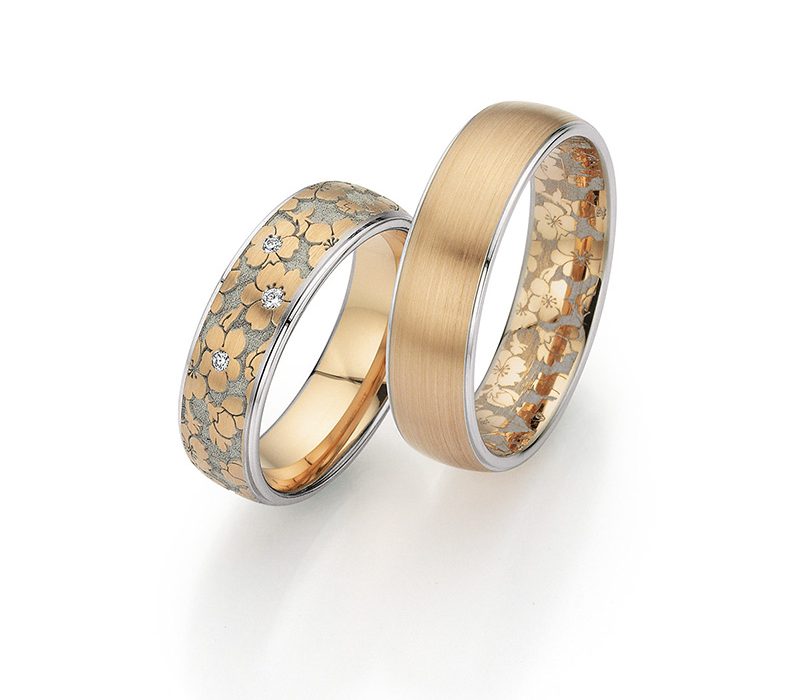
Different styles can be combined:
• Same alloy, different width
• Same profile, different surface
• Common design element
• The outside-in principle
This creates a harmonious pair—without sacrificing identity.
Mistake 8 – Making decisions without comparing options
Often, there is no transparent overview of variants.
A digital configurator can help to highlight differences:
• Compare alloys
• Vary ring widths
• Test surfaces
• Simulate diamond sizes
With the Fischer Configurator, you can take your time to explore various options before making your final decision together with a Fischer jewelry partner.
This allows you to combine digital guidance with personal advice.
Make conscious decisions rather than impulsive ones
Most mistakes when buying wedding rings are not caused by carelessness, but by uncertainty or time pressure.
With a little preparation, they can be easily avoided:
• Start early
• Prioritize quality
• Test comfort
• Think long-term about design
• Decide together
Wedding rings are more than just jewelry.
They accompany your story.
If you take your time—and focus on craftsmanship, substance, and advice—you will make a decision that will still feel right years later.